


(Updated last January 25, 2021)
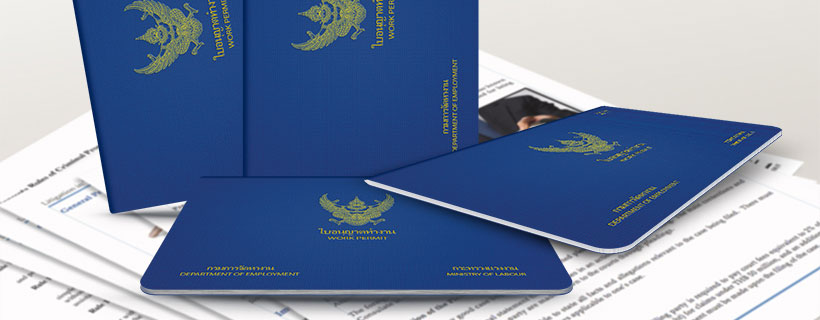
A foreigner can apply for a work permit if he holds a non-immigrant visa or a resident visa such as marriage visa, an employer who can provide pertinent documents for and can meet the cap of paid-up capitalization and the occupation he intends to work with is not prohibited to foreigners.
If you are a foreign national with intentions to work in Thailand, you have to make sure that your intended job and skills do not belong to the categories generally closed for Thai nationals only.
Thai Work Permit Requirements
Below are the steps in securing a Work Permit.
Steps in securing a Work Permit
Step 1: Securing a Non-Immigrant Visa
To be granted with a non-immigrant visa, you are required to present the following:
- A Thai company offered you a job in Thailand or you are planning to start a company to employ yourself. If you are offered with a job in the Kingdom, you are ought to present the invitation and or sponsorship letter of the prospective employer in Thailand.
- A request from the company that you shall be given a non-immigrant visa that will allow the company to apply for a work permit for you.
- The company can attest that you are dependable, upstanding, law abiding and guarantees that you will respect the laws and customs of the nation.
Also, you must apply for a non-immigrant visa at least 30 days prior to departure for Thailand. The consulate or consular office will ask for copies of the registration documents and financial statements of the company. These documents should be issued by the company.
If granted, you are allowed to have a temporary stay in Thailand for a period of 90 days only.
Step 2: Obtaining the Work Permit
The following are the documents that you must present:
- Passport copies with every page signed by the you
- Non-immigrant visa
- Departure Card TM. 6
- Scholastic records (certified copies by your embassy in Thailand)
- Transcript of Records (certified copies by your embassy in Thailand)
- Certificates or licenses of the applicant (certified copies)
- Curriculum Vitae or Resume that has detailed description of your previous employment, position, duties, performance and length and place of employment.
- 6 pieces of recent photos (within 6 months before application) in 5×6 centimeters in size, wearing full face and on business attire.
- Marriage certificate if you are married to a Thai national (certified and original copies). Must also include your Thai spouse’s ID card, birth certificates of children (if any) and household registration.
- Medical Certificate issued by a hospital or clinic in Thailand.
The Thai government may require you to have these documents to be certified by your country’s embassy. Also, a translation from the foreign language to the Thai language may be required.
Documents that the employer provides:
- Commercial Registration Department Certificate that shows the company to be duly registered as a juristic entity and bearing the name of the Managing Director and/or Director, its objectives and registered capital.
- A Commercial Registration Department certified Shareholder’s List.
- A Factory Department, Ministry of Industry issued Factory License (if required).
- VAT Certificate – Phor Phor 20
- Withholding Tax – Phor Ngor Dor 1 (if renewing the work permit)
All these documents should have a seal of the company stamped on every page, true and authorized signature(s) of the Managing Director and/or Directors next to the seal. These will be required by the government officials who will examine the application.
The approval of the work permit does not rely heavily on the documents to be submitted alone. The deciding factor is usually the job description. Your job description must contain a detailed description of the required skills of your line of work, skills that Thai nationals are not likely to have.
You and your employer must justify why the Thai government must give you a working visa. Once your application for a work permit is approved, you will be allowed to work on the same company and location. If you transfer to another employer or location, you need to obtain a new application for work permit. You are not allowed to work on a job different from what you were given a work permit for. You are also not allowed to work with an employer different from what was stated in your application.
In case of ending an employment, you are required for you to return your work permit to the Labor Department. You have to do so in order for you apply for another work permit with another company.
Step 3: The Tax ID card
When your work permit is being processed, your company is supposed to apply a Thai taxpayer identification card for you at the Thailand Revenue Department. On that card is a Tax ID number that you will use in filling up tax documents.
Step 4: Obtaining the Thai Visa Extension and Re-entry Permit
- Visa – is issued outside of Thailand by a Thai embassy or consulate. This gives you access to enter the country. Once in the Kingdom, an immigration officer will stamp a date on your passport called “extension of stay.”
- Extension of Stay – this is the time period in which you are allowed to stay in Thailand. This is stamped by the immigration officer at the border checkpoint upon arrival or by the immigration police after a request for extension of stay.
Misunderstanding the difference between the extension of stay and the re-entry permit may lead to certain consequences.
The extension of stay stamp is the controlling date. Meaning, your length of stay is dependent on the said date. Your work permit and re-entry permit is dependent on the extension of stay date.
However, if you leave Thailand without a re-entry permit, both your extension of stay and work permit will be cancelled.
If you were not able to obtain an extension of stay stamp even if you are holding a Thai work permit, you may still apply for a 1 year non-immigrant B visa from a Thai embassy. This is valid for 1 year with multiple entries and you are no longer required to obtain a re-entry permit.
Step 5: Renewing Your Visa and Work Permit
You have to renew your length of stay in Thailand first before you can renew your work permit. You may do this while still in Thailand or you may do it abroad and apply at the Thai Embassy or Consulate in another country.
If you are required to exit Thailand first before you can renew your work permit, you will need to furnish the Thai Embassy or Consulate with copies of your work permit, new recommendation letter from your company, the company’s registration documents, financial and tax reports.
If you have a long term extension of stay, you are required to report to the Thai immigration Police every 90 days. For the 1 year non-immigrant multiple entry visa holders, they can simply cross border to another country and come back to Thailand to renew their extension of stay.
With your Thai company-employers’ sponsorship, you can apply for a work permit. See Siam Legal’s Thai Work Permit Application page.